For years, the gaming industry — especially the world of casinos and betting — has built much of its model around a primarily transactional logic: deposits, bets, withdrawals. Everything revolved around the operation. The individual action. The movement of money.
But that approach alone is no longer enough.
Today, the real shift is not happening only in game mechanics, but in the very nature of the experience itself. What is transforming the industry is the convergence of three forces that, together, are redefining the rules of the sector: Social + Artificial Intelligence + Virtual Reality.
From gaming as an action to gaming as an experience
For a long time, the objective was clear: to offer a functional, attractive, and efficient platform to play. However, user expectations have evolved. People are no longer looking only to bet or take part in an isolated dynamic. They want something deeper.
They want to be there.
They want to share.
They want to compete.
They want to belong.
That is the turning point.
What we call social gaming is no longer a complementary feature or a simple layer of interaction. It is no longer an “extra” within the experience; today, it is becoming the core. Because modern users do not only value the outcome of the game, but also the context in which it happens, the identity they project within that environment, and the connection they build with others.
Virtual reality does not replace gaming: it transforms it
When people talk about virtual reality in gaming, it is often seen as a futuristic innovation or a striking technological extension. But its true potential goes far beyond visual impact.
Virtual reality is not here to replace traditional gaming. It is here to transform it completely.
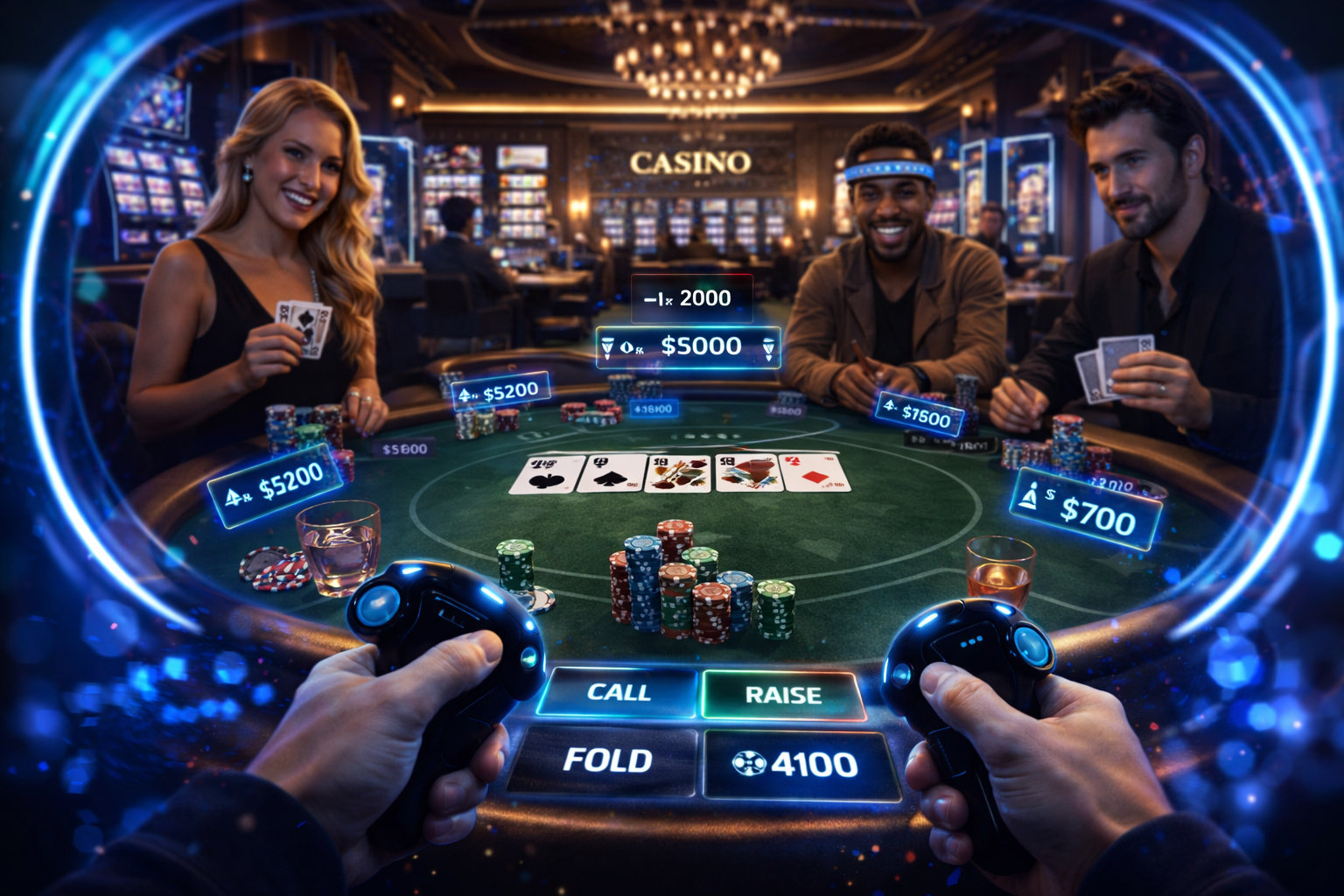
We are talking about experiences where users no longer simply access a casino — they immerse themselves in it. Where a table is no longer a static space, but a living, immersive, and shared environment. Where interaction with others happens in real time, inside a digital dimension that feels present, dynamic, and authentic.
In this new landscape, concepts emerge that will change how we understand entertainment:
- Casinos you do not enter — you step inside them
- Tables where you do not play alone — you interact with real people in real time
- Experiences where digital identity matters just as much as real identity
Here, gaming stops being just an action in front of a screen and starts feeling like a true presence inside a world.
Artificial Intelligence: the invisible engine of the new experience
If virtual reality builds the environment, artificial intelligence brings it to life.
AI is the piece that allows these worlds to be not static, but adaptive, fluid, and deeply personalized. Its value lies not only in automating processes, but in interpreting behavior, anticipating needs, and creating experiences that feel more relevant to each user.
In practice, this means AI can:
Personalize entire environments for each user
Not everyone looks for the same thing when they play. Some prioritize competition, others casual entertainment, others social status, exploration, or interaction. AI makes it possible to adapt environments, dynamics, stimuli, and even user journeys according to each person’s profile and behavior.
Predict social behavior and adapt the experience live
Interaction no longer has to be generic. AI can identify social patterns, participation preferences, moments of higher engagement, and even affinities between users to make the experience feel more organic, communal, and alive.
Create engagement dynamics that go beyond financial incentives
One of the most important shifts in the new era of gaming is that engagement will no longer depend solely on rewards or betting. AI makes it possible to build systems of progression, belonging, reputation, collaboration, and recognition that strengthen user retention for reasons that are far more emotional and experiential.
The real competitive edge will no longer be having more users
For a long time, the race was focused on volume: more traffic, more registrations, more deposits, more sessions.
But the future of gaming will not necessarily belong to the one with the most users. It will belong to the one that succeeds in building the most compelling worlds to stay in.
That will be the new competitive advantage.
It will not be enough to offer games. It will be necessary to build ecosystems.
It will not be enough to capture attention. It will be necessary to create presence.
It will not be enough to have technology. It will be necessary to design memorable experiences.
Because when users feel they are part of an environment, that their identity matters, that they can interact, evolve, and project themselves within that space, their relationship with the platform changes radically. It is no longer just about usage. It becomes about connection.
Gaming, community, and presence: a new stage for the industry
We are entering a phase where gaming looks less and less like a transaction-based platform and more and more like a universe of connected experiences.
In this context, concepts such as community, presence, digital identity, and immersion stop being trends and become strategic pillars. The industry players who understand this first will be the ones setting the pace for the years ahead.
At Land Vegas, we believe gaming is not just entertainment.
It is experience.
It is community.
It is presence.
And when you bring together social + artificial intelligence + virtual reality, you are no longer simply playing.
You are inside the game.